


How to Maintain Gold Plated Jewelry: Care Guide
Table of Contents
- How to Maintain Gold Plated Jewelry: Daily Habits That Protect the Finish
- Does Gold Plated Jewelry Tarnish? What Actually Causes Discoloration
- How to Clean Gold Plated Jewelry Without Damaging the Coating
- How to Store Gold Plated Jewelry So It Stays Bright
- When to Remove Gold Plated Jewelry: Showers, Swimming, and Sweat
- Re-Plating, Travel Care, and When Maintenance Beats Replacement
- Frequently Asked Questions
Last Updated: September 15, 2026
How to Maintain Gold Plated Jewelry: Daily Habits That Protect the Finish
Gold plated jewelry is a base metal core covered with a thin layer of gold, and that layer wears away first. Most damage is preventable, and the fixes take seconds.
Two habits do most of the work: put jewelry on last, after perfume, lotion, and hairspray dry, and take it off first, before washing hands, working out, or bed.
Put Jewelry On Last, Take It Off First
This sequencing rule prevents more damage than any cleaning product. Cosmetics and skincare contain alcohols, acids, and oils that attack the gold layer directly.
At night, skin oils, perspiration, and leftover product accumulate; removing pieces before bed stops that residue from hardening into a dulling film.
Keep Moisture, Perfume, and Lotion Away
Water isn't the enemy by itself; moisture becomes a problem when it traps chemicals against the base metal. A wet ring sitting against soap residue is a corrosion setup, not a cleaning moment.
A common mistake is treating plated jewelry like solid gold. A plated piece has a protective coating measured in microns, and that coating decides how long it stays bright.
Does Gold Plated Jewelry Tarnish? What Actually Causes Discoloration
Yes, gold plated jewelry tarnishes, but the gold itself usually isn't what changes color. Tarnish is oxidation of the base metal underneath, showing through once the plating thins or develops microscopic gaps; the gold layer resists oxidation, the copper or brass core does not.
Three forces drive the process: moisture creates the chemical reaction, skin oils and perspiration shift surface pH, and abrasive cleaners or rough handling scratch the coating.
Gold Vermeil vs. Flash Plating: Why Thickness Changes Everything
Gold vermeil is a specific standard: a sterling silver base with a gold layer of at least 2.5 microns (the FTC). Flash plating is a much thinner gold deposit, often well under 1 micron (the FTC).
That thickness difference is the whole story: vermeil tolerates years of regular wear, while flash-plated pieces may show wear within months of daily use.
| Plating Type | Gold Thickness | Base Metal | Typical Wear Life | Care Level |
|---|---|---|---|---|
| Flash plating | Under 1 micron | Brass or copper | Months with daily wear | High maintenance |
| Standard plating | 1-2.5 microns | Brass or copper | 1-2 years | Moderate |
| Gold vermeil | 2.5+ microns | Sterling silver | Several years | Lower maintenance |
Treat flash-plated pieces as occasional-wear jewelry; vermeil gives you more room to relax, but the same rules still extend its life.
How to Clean Gold Plated Jewelry Without Damaging the Coating
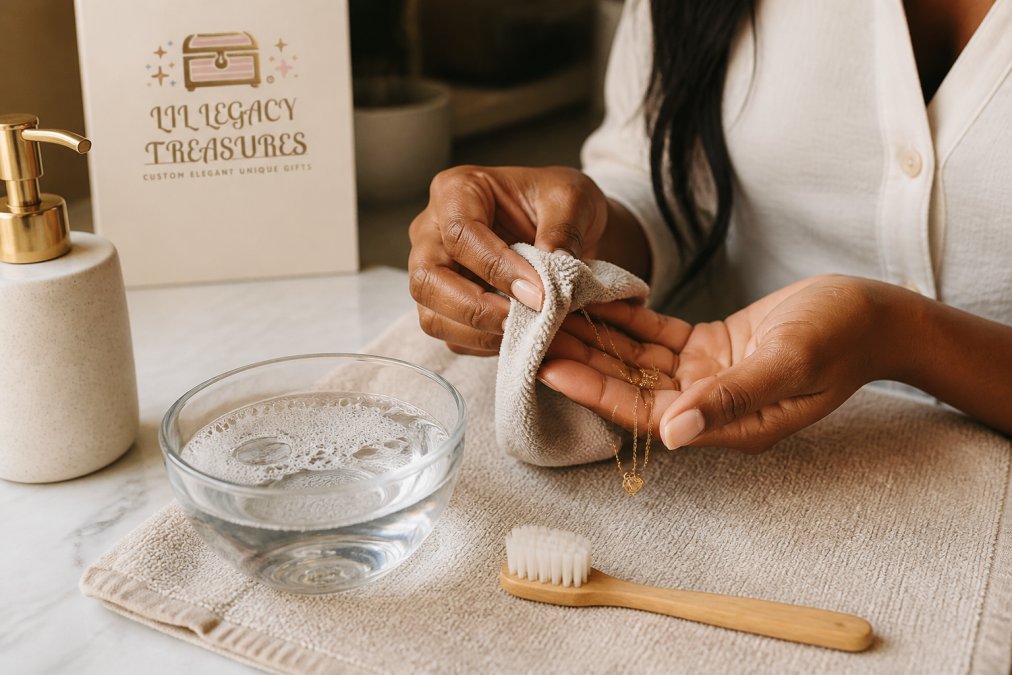
The safe method is simple: lukewarm water, a drop of gentle soap, and your hands. Skip ultrasonic cleaners, steamers, and anything labeled "dip" or "instant shine." Those products are formulated for solid metal and will lift plating.
Follow these steps:
- Fill a small bowl with lukewarm water and add one drop of mild, phosphate-free dish soap.
- Submerge the piece and let it sit for one to two minutes to loosen residue.
- Use a soft-bristled brush or your fingertip to gently work around crevices. Never scrub.
- Rinse under lukewarm running water to remove all soap residue.
- Pat dry immediately with a soft microfiber cloth. Do not air dry.
- Let the piece sit for an hour before wearing or storing it.
Cleaning Solutions and Tools to Avoid
Some products cause immediate, irreversible damage. Keep these away from plated pieces:
- Abrasive cleaners and baking soda paste, which scratch the protective coating
- Ultrasonic and steam cleaners, which force plating to lift at the edges
- Chlorine and bleach, which corrode the base metal through any gap in the gold
- Ammonia-based glass cleaners and acetone, which break down the coating chemically
- Paper towels and rough cloths, which leave micro-scratches that dull the finish
Stick with a jewelry care guidance from the Gemological Institute of America approach: mild soap, soft tools, and immediate drying.
How to Store Gold Plated Jewelry So It Stays Bright
Air is the enemy. Oxidation needs oxygen and moisture, so airtight storage removes both, the single highest-impact change most people can make.
Match Storage to the Base Metal
The base metal underneath the gold decides what you're fighting:
- Brass and copper cores oxidize fastest and discolor first. These need the tightest seal and the most frequent anti-tarnish strip replacement.
- Sterling silver cores (the base for gold vermeil) tarnish through sulfur exposure, not just moisture. Silver tarnish can migrate up through thin gold and show as a dark or greenish cast.
- Stainless steel cores are the most stable and rarely discolor, but the gold layer still scratches, so separation matters more than sealing.
If you don't know your base metal, a jeweler can identify it in seconds, telling you how aggressive your storage needs to be.
The Storage Setup That Actually Works
Store each piece separately in a soft pouch or lined compartment to prevent scratching. Add an anti-tarnish strip, replacing it every few months or sooner if darkened, and keep the box in a cool, dry drawer away from humid bathrooms.
A few specifics that separate a working setup from a decorative one:
- Use a sealed container, not an open tray. A zip pouch inside a lidded box beats a velvet tray on a dresser.
- Skip foam inserts that off-gas. Some older foam and rubber liners release sulfur compounds that accelerate silver-core tarnish.
- Do not store pieces touching each other. Even soft gold layers scratch against harder stones and clasps.
- Keep silica gel or an anti-tarnish strip in the container, and refresh it on a schedule rather than when you remember.
A lined jewelry box with individual compartments solves tangling and moisture at once. The Legacy Luxe Personalized Jewelry Keepsake Box pairs soft-lined storage with personalization.

Travel and Humidity Storage
This is where plated jewelry takes its worst hits: humidity in transit, coastal salt air, and hotel bathrooms combine moisture with heat, the fastest path to base-metal oxidation.
- Pack each piece in its own small pouch, then place the pouches in a hard case.
When to Remove Gold Plated Jewelry: Showers, Swimming, and Sweat
Re-Plating, Travel Care, and When Maintenance Beats Replacement
How Re-Plating Actually Works
Three things determine whether re-plating is worth it:
When to Re-Plate vs. Replace
Here's when to choose which:
| Situation | Better Option | Why |
|---|---|---|
| Sentimental piece with worn plating | Re-plate | Keeps the original piece intact |
| Flash-plated fashion piece, heavy wear | Replace | Re-plating cost approaches replacement |
| Vermeil piece showing thin spots | Re-plate | Base metal is high quality; worth restoring |
| Piece with broken settings or stones | Repair first | Structural issues come before cosmetics |
| Sterling-silver-core piece with deep tarnish | Re-plate after cleaning | Tarnish must be removed before new gold goes on |
| Base metal already pitted or corroded | Replace | New plating will not adhere evenly |
Travel Care for Plated Pieces
A few travel-specific habits that protect plating:
Maintenance Beats Replacement When the Piece Carries Meaning
Frequently Asked Questions
How do you keep gold plated jewelry from tarnishing?
Keep gold plated jewelry dry and away from chemicals. Put it on after perfume, lotion, and hairspray have dried, and take it off before showering, swimming, or cleaning. Wipe it with a soft microfiber cloth after each wear to remove skin oils and perspiration, then store it in an airtight container with an anti-tarnish strip. These daily habits slow oxidation and protect the plating.
Can I take a shower with gold plated jewelry?
Skip it. Soap scum, shampoo residue, and hot water wear down the protective coating on plated pieces and leave a dull film. Chlorine in tap water speeds up corrosion on the base metal underneath. If your jewelry gets wet, pat it dry right away with a soft cloth. A quick rinse-free routine keeps gold plated jewelry looking new much longer.
How long does gold plated jewelry last if worn every day?
It depends on plating thickness and care. Flash-plated pieces may show wear within a few months of daily wear, while thicker gold vermeil can last one to three years with good habits. Removing jewelry before showers, workouts, and cleaning, plus regular gentle cleaning and airtight storage, is the biggest factor in how long the finish holds up.
What is the best way to clean gold plated jewelry without damaging it?
Use lukewarm water with a drop of gentle, phosphate-free soap. Submerge the piece briefly, work the solution around with a soft-bristled brush, then rinse and pat dry with a microfiber cloth. Avoid abrasive cleaners, baking soda, toothpaste, and ultrasonic machines, which strip the plating. Dry completely before storing to prevent residue buildup and moisture exposure.

