


Why Handmade Gifts Last Longer: The Real Reasons
Table of Contents
- Why Handmade Gifts Last Longer Than Store-Bought Presents
- The Benefits of Handmade Gifts: Thoughtfulness You Can Hold
- What Actually Makes a Handmade Gift Last Longer
- Handmade Gifts That Last a Lifetime: What to Look For
- How to Care for Handmade Jewelry and Keepsakes
- From Keepsake to Heirloom Gifts: Building a Legacy
- When Handmade Gifts Do Not Last Longer
- Conclusion
- Frequently Asked Questions
Last Updated: October 15, 2026
Why Handmade Gifts Last Longer Than Store-Bought Presents
A handmade gift lasts longer because the maker chooses better materials, builds in more care, and makes the piece for one person instead of a warehouse shelf, which is why handmade gifts hold up when mass-produced presents fade, tarnish, or break.
At Lil Legacy Treasures, we build made-to-order keepsakes, so we think about this a lot. The FTC guidance on gift and advertising claims reminds sellers to back up quality claims with real facts, which is fair. So here they are.
Below, we break down what makes a handmade gift outlast a store-bought one, how to spot quality before you buy, and how to care for a keepsake so it lasts decades.
The Benefits of Handmade Gifts: Thoughtfulness You Can Hold
The benefits of handmade gifts start with intention. Someone chose your name, your milestone, and your story, then made a piece around it.
That shows up in small ways:
- A name engraved by laser, not printed on a sticker
- Materials picked for the person, not the price point
- A design that fits one story, not a thousand
- Real time and effort spent on a single item
Personalization is the emotional core: a custom-made gift says the giver paid attention, which is why people keep handmade pieces long after the trend behind a store-bought gift has passed.
The thoughtfulness is not just sentimental. It changes how you treat the item. You keep it safe. You repair it. You pass it down.
What Actually Makes a Handmade Gift Last Longer
Physical durability comes down to four things: material quality, construction method, finish, and repairability. A maker who controls all four can build something that outlives a factory item; skip any one and the advantage shrinks.
Store-bought gifts often cut corners on materials to hit a low price; a handmade piece usually does the opposite, because the maker's name is on it. But "handmade" is not a durability guarantee on its own, it is a starting condition a good maker turns into a real one.
Material Quality and Construction
Material quality is the biggest single factor in how long a gift lasts. Solid hardwood, sterling silver, and thick cotton outlast particle board, plated metal, and thin blends because solid material wears down slowly and evenly, while thin coatings and laminates fail at the bond line, not the surface.
Construction matters just as much. Look for:
- Joinery over glue, such as dovetails or mortise-and-tenon, because mechanical joints tolerate movement while glue lines crack
- Deep engraving, not shallow surface printing that rubs off with handling
- Solid metal, not plating that wears through at high-contact points like clasps and ring bands
- Reinforced stitching on fabric goods, especially at stress points like handles and seams
- Proper finishing, like food-safe oil on wood or a protective sealant, which slows moisture and UV damage
A common mistake is judging a gift by how it looks on day one. Durability shows up in year five, not minute five.
Durability by Craft Type
Different crafts age at different speeds. The ranges below assume normal use plus basic care, treat them as planning estimates, not guarantees, since a neglected piece can fail far sooner and a well-kept one can outlast the range.
| Craft Type | Realistic Lifespan (with care) | What Drives Longevity | Main Failure Mode | Repairable? |
|---|---|---|---|---|
| Solid hardwood (boards, boxes, frames) | Decades to generations | Species density, joinery, oil finish | Water swelling, heat warping, grain lifting | Yes, sand and re-oil |
| Sterling silver jewelry | Generations | Alloy content, solder quality, thickness | Tarnish, clasp fatigue, thin solder joints | Yes, polish, re-solder, replace clasps |
| Gold-filled jewelry | 5-30 years | Thickness of the gold layer, wear points | Layer wears through at contact points | Limited, re-plating is possible but costly |
| Plated or costume jewelry | 1-3 years | Plating thickness, base metal | Plating wears through, base metal corrodes | No, usually replace |
| Hand-knit wool or cotton | Years to decades | Fiber length, ply, gauge | Moths, pilling, holes at stress points | Yes, darning and re-knitting |
| Ceramics and pottery | Decades to centuries | Firing temperature, glaze fit, wall thickness | Chips at rims, thermal shock, glaze crazing | Sometimes, food-safe glaze repair is limited |
| Custom journals and books | Decades | Paper acidity, binding method, cover material | Spine wear, loose signatures, foxing | Yes, rebinding |
| Consumable gifts (candles, soaps, foods) | Weeks to a year | Ingredients, preservatives, storage | Melting, rancidity, evaporation | No, by design |
The pattern is simple. Solid materials and deep work last. Thin coatings and light construction do not. Repairability is the tiebreaker: a piece that can be fixed will outlive a slightly stronger piece that cannot.

Repairability: The Overlooked Longevity Factor
A gift that can be repaired lasts longer than one that cannot, even if the repairable one starts out weaker. This is the biggest difference between a handmade piece and a mass-produced one, and most buyers never ask about it.
Questions that reveal repairability:
- Can the maker re-oil a finish?
- Are components standard sizes, or proprietary?
- Will the maker share care and repair instructions?
A maker who answers those clearly is building for decades; one who cannot is building for the shelf.
Handmade Gifts That Last a Lifetime: What to Look For
Handmade gifts that last a lifetime share a few traits you can check before you buy, ask about materials, construction, and finish.
Use this checklist:
- Does the maker name the exact material?
- Is the engraving or print deep and permanent?
- Are joints, clasps, or seams reinforced?
- Is there a care guide included?
- Can the piece be repaired later?
Ask the maker one question before buying: "What will this look like in ten years?" A good maker has a clear answer. A vague one tells you plenty.
At Lil Legacy Treasures, every piece is made to order, which means we can talk through materials and personalization before anything is cut or engraved. That back-and-forth is where lasting quality starts.
How to Care for Handmade Jewelry and Keepsakes
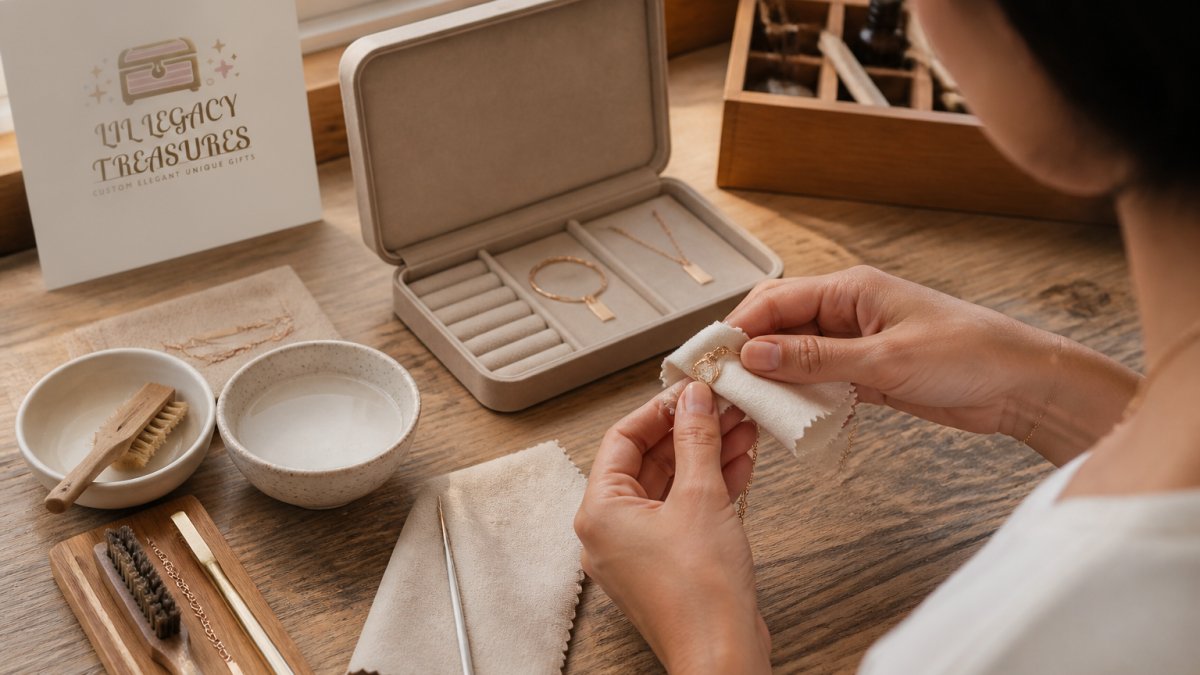
Caring for handmade jewelry and keepsakes comes down to three habits: keep it dry, store it soft, and clean it gently. Most damage comes from moisture, chemicals, and rough storage, not normal wear, so match the routine to the material.
General Habits That Apply to Almost Everything
- Take jewelry off before showering, swimming, or cleaning. Water and cleaners dull finishes, and chlorine and salt are especially hard on metal.
- Store each piece separately in a soft-lined box or pouch to stop scratches. A tarnish-resistant pouch or an anti-tarnish strip slows silver oxidation.
- Polish with a soft cloth, not paper towels or rough fabric, which can leave micro-scratches that dull the surface over time.
- Keep pieces out of direct sunlight and away from radiators. UV fades finishes and heat warps wood and softens adhesives.
- Check clasps, joints, and seams twice a year and tighten or repair anything loose before it fails.
Material-Specific Care
Sterling silver. Tarnish is surface oxidation, not damage, and it polishes out.
Gold-filled and plated jewelry. Wipe after each wear to remove skin oils and lotions, which break down the gold layer.
Legacy Luxe Personalized Heart Charcuterie Board →
Engraved wood. Wipe with a barely damp cloth and dry immediately, never soak.
Ceramics and pottery. Hand-wash when possible, let pieces come to room temperature before hot water to avoid thermal shock, and do not stack heavy items on rims.
Textiles (knitwear, quilts, fabric keepsakes). Hand-wash wool in cool water with gentle detergent, lay flat to dry, and never wring.
Journals and paper keepsakes. Keep them out of damp basements and hot attics, the two environments that age paper fastest, and store upright away from sunlight.
Storage That Actually Protects
A keepsake box with soft-lined compartments does more for longevity than any polish, keeping pieces apart, dry, and out of sunlight. For jewelry, choose a lined box with individual slots or pouches; for larger pieces, a breathable cotton bag beats sealed plastic, which traps moisture.
When to Repair vs. Replace
Repair is usually worth it when the piece is solid material or has sentimental value. Replace when the failure is structural and the material thin. Rule of thumb: if the repair costs less than half a replacement and the piece is solid, repair it.
Ask the maker for a care card when you buy. A maker who provides one has usually thought about repair, replacement parts, and how the piece will age, which is a strong signal of durability.
Match care to material, store pieces separately and dry, and repair early. Most handmade gifts that fail do so from neglect, not from the craft itself.
From Keepsake to Heirloom Gifts: Building a Legacy
An heirloom gift is simply a keepsake that survived long enough to be passed down, the difference is care and material, not luck.
Pieces that become heirlooms usually share:
- Solid, repairable materials
- A story tied to a person or moment
- A name, date, or message that still matters years later
That story is the real reason heirloom gifts get kept. A plain serving tray is replaceable. A tray engraved with a wedding date and two names is not.
This is the work we do at Lil Legacy Treasures. Our Legacy Luxe Personalized Heart Charcuterie Board is laser engraved on natural hardwood, so it works as decor or a serving piece while carrying the names and dates that make it personal. See it here: https://www.lillegacytreasures.com/products/personalized-heart-charcuterie-board

When Handmade Gifts Do Not Last Longer
Handmade does not automatically mean durable, a poorly made gift can fail faster than a good factory item.
Watch for these cases:
- Thin plating on "handmade" jewelry that tarnishes within a year
- Soft woods that dent and scratch easily
- Loose construction held together by weak glue
- Delicate crafts meant for display, not daily use
- No care instructions, which usually signals no thought about longevity
So the honest answer: handmade gifts last longer when the maker uses solid materials and builds for repair. Skip those and the advantage disappears.
Handmade gifts last longer because of material choice and construction, not the label. Check what the piece is made of and how it is built before you buy.
Conclusion
Choosing a gift that lasts takes more thought than grabbing something off a shelf, asking about materials, construction, and care, and picking a piece built to be kept.
That is exactly what we do at Lil Legacy Treasures. Our keepsakes are made to order, personalized with your story, and built from quality materials meant to be treasured for generations. From engraved jewelry boxes to custom journals, every piece is designed to hold a moment, not just fill a shelf.

Shop our best sellers and start a gift that lasts.
Frequently Asked Questions
What makes a handmade gift last longer than a store-bought one?
Handmade gifts often use higher-quality materials and more careful construction than mass-produced items. A maker selects wood, metal, or fabric with durability in mind, then finishes each piece by hand. That attention to detail, from deep engraving to reinforced stitching, means the gift resists wear better. Store-bought items are built for speed and volume, while handmade gifts are built to be kept.
Are handmade gifts more durable than mass-produced gifts?
Not automatically. Durability depends on the materials and techniques used, not the label. A hand-engraved hardwood board or a personalized jewelry box with soft-lined compartments can outlast anything from a big-box store. Ask what materials were used and how the piece was finished before assuming handmade means sturdier.
How should you care for handmade keepsakes so they last?
Keep handmade jewelry away from water, perfume, and harsh cleaners. Store pieces in a soft-lined box, like a personalized jewelry keepsake box, to prevent scratches and tarnish. For wooden items such as a personalized charcuterie board, hand wash only and never soak. Reapply food-safe oil to wood every few months. Journals should be kept dry and away from direct sunlight to protect the cover and binding.
What handmade gifts can become family heirlooms?
Engraved jewelry, personalized wooden boards, custom hardcover journals, and keepsake boxes all have heirloom potential. The key is durable materials plus personalization: a name, date, or message that ties the piece to a specific person and moment. A Legacy Luxe Personalized Jewelry Keepsake Box, for example, stores heirlooms while being one itself. Heirloom gifts are chosen to be passed down, not used up.

