


How to Start Intentional Home Decor in Your Space
Last Updated: November 1, 2026
Quick Summary
Intentional home decor means choosing every piece in a room on purpose so each item earns its place through meaning, function, or beauty. Follow a clear order: decide how you want the room to feel, take stock of what you already own, plan the layout, choose a color palette and lighting plan, then add meaningful pieces last.
- Write one sentence describing how you want the room to feel, then use it as a filter for every choice.
- Audit what you own first using five zones: Keep, Move, Repair, Donate, and Replace.
- Pick three colors, a dominant neutral, a secondary shade, and one accent, and write them down.
- Layer three light sources: ambient, task, and accent, with at least two besides the ceiling fixture.
- Split any room into three phases: foundation, anchors, then layers, so cost spreads over time.
Table of Contents
- What Intentional Home Decor Actually Means
- Step 1: Define Your Personal Style and Decorating Goals
- Step 2: Audit What You Already Own Before You Buy
- Step 3: Plan the Layout, Color Palette, and Lighting
- How to Create an Intentional Home on a Phased Budget
- Meaningful Home Decor Ideas That Tell Your Story
- Slow Decorating: Why Waiting Makes a Home Feel Better
- Shop Pieces Made to Be Kept, Not Replaced
- Frequently Asked Questions
What Intentional Home Decor Actually Means
Intentional home decor is the practice of choosing every piece in a room on purpose, so each item earns its place through meaning, function, or beauty. The difference between rooms that feel collected and rooms that feel crowded is worth understanding before you buy anything.
Most people do this backwards: they buy what looks good in a store, bring it home, and hope it fits. A more deliberate approach follows a clear order:
- Decide how you want the room to feel
- Take stock of what you already own
- Plan the layout before any purchase
That order separates a home that feels calm from one that feels like a storage unit with a couch.
A Simple Checklist for an Intentional Room
Use this checklist before you buy anything for a space:
- I can name the feeling I want in this room in one sentence
- Every piece in the room has a purpose or a story
- I measured the space and know my furniture footprint
If you can check most of these boxes, the room is already working. If not, the steps below will get you there.
Step 1: Define Your Personal Style and Decorating Goals
Start with a sentence, not a shopping list.
Next, name your style in plain words. For concrete examples of feminine home decor trends to help you name your own aesthetic, browse this article.
Then set decorating goals for the room itself. Ask two questions:
- Function: What happens in this room? Reading, hosting, sleeping, working?
- Feeling: What should it feel like at 8 a.m. and at 8 p.m.?
A room that serves two purposes needs furniture that shifts; a room built for rest needs softer light and fewer distractions. Write your answers down, you will refer to them more than you expect.
Step 2: Audit What You Already Own Before You Buy
The fastest way to create an intentional home is to shop your own house first. Most people own more than they realize, and much of it is in the wrong room.
Set aside a few hours per room. You will need five bins or floor zones, a tape measure, a notebook or phone note, and painter's tape. Label the zones: Keep, Move, Repair, Donate, and Replace.
The Five-Zone Sort
Pick up each object and run it through this order of questions. Stop at the first yes.
- Is it broken, missing parts, or unsafe? If it cannot be repaired for less than a comparable replacement, it goes to Replace. Note what it was and why it failed so you do not buy the same thing again.
- Does it belong in this room? If it is useful or meaningful but belongs elsewhere, it goes to Move. Tape a note with the destination room.
- Can it be fixed in under an hour with supplies you already own? Tighten a screw, replace a lamp cord, touch up a scratch, rehang a frame. If yes, it goes to Repair with a specific task written on the note.
- Is it useful, meaningful, or genuinely beautiful to you, right now? If yes, Keep. If it is fine but belongs to a different life or style, Donate.
- Everything else goes to Donate, including gifts you dislike, duplicates, and pieces you keep moving from room to room without ever using.
Build a Written Inventory
When the sort is done, group the Keep pile by category: textiles, artwork, lighting, decorative objects, storage, and furniture. Count each category and write the counts down.
A common pattern is discovering you own four throw blankets, three of which live in a closet, while the living room has none. The inventory tells you where the actual gap is, which is usually not where you thought.
Measure the Keep furniture while you are at it. Record width, depth, and height for each large piece.
Handle the Hard Cases
Some items stall the audit. Here is how to move past them:
- Sentimental but not displayed: Store it in a labeled bin with a date. If you have not opened the bin in a year, revisit whether it needs to stay.
- Gifts you dislike: Donate without guilt. The gift served its purpose when it was given. Keeping it in a closet does not honor the giver.
- Expensive mistakes: A piece you paid a lot for but never liked is still a mistake. Keeping it because of the price makes you pay twice, once in money, once in a room that does not work.
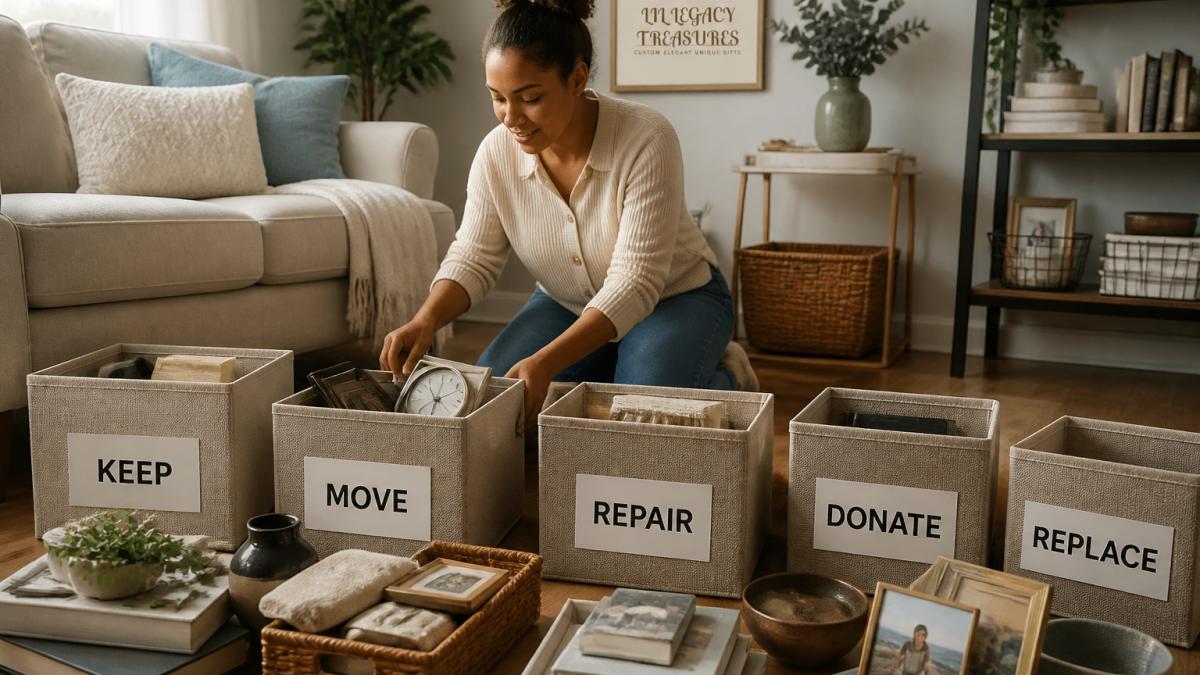
What the Audit Buys You
This step clears visual clutter and produces a shopping list grounded in what you actually lack. A common mistake is buying a new vase when three are already in a cabinet. Let it go, the room will breathe better without it.
When the audit is done, you have three outputs: a written inventory by category, a measured list of large furniture, and a short Replace list of items that failed for a specific reason. Those feed directly into layout, color, and budget decisions.
Step 3: Plan the Layout, Color Palette, and Lighting
Measure the room before you move a single piece of furniture. Note the length of each wall, the height of the ceiling, and where the doors and windows sit. Then sketch a simple floor plan on paper or in a free room-planning app. Mark traffic paths first, since walking space decides furniture placement more than anything else.
Layout: Start With the Walkways
Aim for generous clear walking space on main paths and comfortable room between a sofa and a coffee table. Pull furniture off the walls where the room allows it; floating a sofa a few inches forward often makes a small room feel larger.
Furniture scale matters as much as style. A sofa that overwhelms a small room makes the whole space feel tight, and a rug that is too small leaves the seating area floating.
Color: Three Colors, Written Down
For color, pick three: a dominant neutral, a secondary shade, and one accent. Write down the actual paint colors or fabric swatches so you can match them in a store.
A practical test: hold your three swatches together at the paint counter and again in the room's natural light. Colors shift between store lighting and afternoon sun. If the accent feels loud against the neutral, reduce its share rather than changing the hue.
Inspirational LED Light | Legacy, Pretty Girl, Becoming Her, Faith & Favor →
Lighting: Layer Three Sources
Lighting is the step most people skip. A single ceiling light flattens a room. Layer three sources instead:
- Ambient: ceiling or overhead light for general brightness
- Task: a floor lamp or desk lamp for reading and working
- Accent: a small lamp or candle for warmth in the evening
A common target is at least two light sources besides the ceiling fixture in any room you use after dark. Warm bulbs suit living and sleeping spaces, while cooler bulbs can work well for task areas. Put lamps on dimmers or smart plugs where you can; dimming is the cheapest way to change a room's mood at night.
Natural light counts too. Hang mirrors opposite windows to bounce daylight deeper into the room, and keep heavy curtains open during the day. In rentals, choose floor lamps and plug-in sconces over hardwired fixtures.
How to Create an Intentional Home on a Phased Budget
You do not need to finish a room in one weekend. Phased decorating spreads cost over time and gives you room to live with choices before committing.
| Phase | What to Do | Typical Timeline | Where the Money Goes |
|---|---|---|---|
| Phase 1: Foundation | Measure, declutter, set the layout, choose paint colors | 1-2 weekends | Paint, basic storage, any repairs |
| Phase 2: Anchors | Buy the large pieces: seating, rug, main light source | 1-3 months | Furniture and lighting |
| Phase 3: Layers | Add textiles, artwork, accessories, meaningful objects | Ongoing | Smaller, lower-cost pieces |
Start with fixed finishes when your budget allows.
Watch out: buying accessories first is the most common budget mistake.
A phased plan also lets you wait for the right piece instead of settling for a fast one. That patience is the whole point.
Meaningful Home Decor Ideas That Tell Your Story
The pieces people remember in a home are rarely the expensive ones. They are the ones with a story: a framed photo from a trip, a journal on the nightstand, a small lamp that says something you believe.
Here is how we would layer meaning into a room:
- Display three to five personal objects rather than twenty. Fewer pieces get noticed.
- Group framed photos by moment, not by frame color.
- Keep one item in each room that makes you pause.
If you want specific accessory ideas that feel personal rather than generic, this guide to feminine apartment accessories is a good next read. And if you are shopping for a housewarming gift or a piece to warm up your own space, these cozy room decor gifts are worth a look.
Meaningful decor also means letting some surfaces stay empty. A bare shelf is not a failure. It is space for the next thing that matters.
Slow Decorating: Why Waiting Makes a Home Feel Better
Slow decorating is the practice of furnishing a home gradually, choosing fewer and better pieces over time.
When you wait, you learn how you actually use a room. You notice where the light falls in the afternoon. Waiting turns guesses into decisions.
Handmade and well-made pieces fit this approach naturally, because they are built to stay. If you want to understand why those pieces outlast mass-produced ones, this explanation of why handmade gifts last longer covers the reasons in detail.
Slow decorating has a practical side too. Buying one good piece a season costs less per year than replacing cheap items every few months, and it keeps usable furniture out of landfills.
Shop Pieces Made to Be Kept, Not Replaced
Some decor earns its place because it does two jobs at once: it looks right in the room, and it means something. That is the standard we build to at Lil Legacy Treasures. Pieces are made to order with intention.
If you want a starting point for an intentional room, the Becoming Her Collection brings together an inspirational journal, a 16 oz glass can, and a warm LED light in one set.

For a smaller addition, the Inspirational LED Light comes in Legacy, Pretty Girl, Becoming Her, Faith & Favor, and Boss Lady designs at $24.99.
Best for: anyone building a room around meaning rather than matching a catalog. Skip if: you need a full furniture set in one order.
Frequently Asked Questions
What does intentional home decor mean?
Intentional home decor means every piece in a room earns its place. Before buying anything, you decide how the room should feel and function, then choose items that serve that goal. It replaces impulse buying with a short checklist: does this fit my style, my layout, and my daily routine? A single meaningful object, like a personalized keepsake or an affirmation lamp, often does more for a room than a cart full of trend pieces.
How do I decorate with items I already own?
Start with an audit. Empty one shelf or surface at a time and sort everything into keep, repair, donate, and store piles. Keep only what you love or use. Then regroup what remains: books stacked by color, framed photos clustered on one wall, textiles folded in a basket. Moving existing pieces to new rooms often refreshes a space for free. Write down the gaps that remain so you buy only what the room truly needs.
How can I make a room feel intentional on a budget?
Phase the work instead of buying everything at once. Fix layout and lighting first, since those cost little and change how a room feels. Shop your own home for accessories, then set a small monthly budget for one quality piece rather than several cheap ones. Slow decorating keeps spending steady and prevents the clutter that comes from filling a room too fast.
How do I choose decor that reflects my values and lifestyle?
Match decor to how you actually live. If you host often, prioritize durable textiles and clear surfaces. If you work from home, give your desk a focal point that keeps you calm. Choose materials and makers you trust, and favor pieces with a story, like a custom journal or engraved acrylic light, over generic filler. When an object connects to a milestone or a person you love, the room feels personal without extra styling effort.
Starting an intentional home is a decision, not a shopping spree. It asks you to slow down, measure first, and choose pieces you will still want in ten years. Lil Legacy Treasures makes that easier with made-to-order keepsakes, personalized designs, and premium pieces built to be treasured for generations. Get started with Lil Legacy Treasures and build a home where every object has a reason to be there.


